Plumbing Repair
 Water Heaters
 Gas Lines & Appliances
 Gas Leak Detection
 Drain Cleaning
 Sewer Line Services
 Leak Detection
 Repiping
 Water Softeners & Filtration
 Fixture Installation
 Emergency & Same-Day
Tankless vs. Tank Water Heaters: An Engineer's Take for North Alabama Homes
Tankless isn't automatically better. Here's how to decide based on your gas supply, water hardness, household size and budget, with real installed prices.
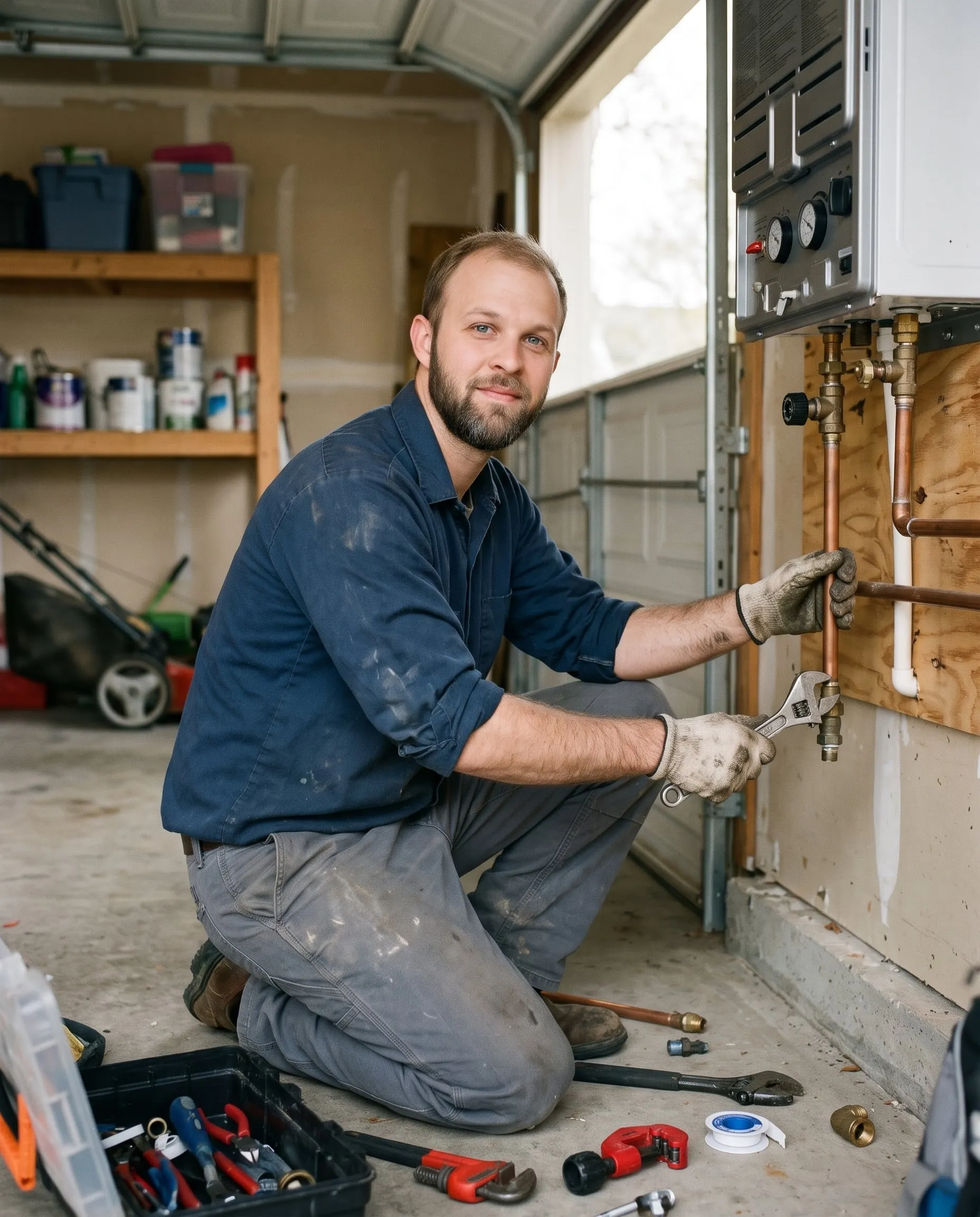
“Should I go tankless?” is one of the most common questions we get. The honest answer is: it depends on your house. Here’s how to think about it the way an engineer would, with the actual numbers.
The short version
| Gas tank (50 gal) | Gas tankless | |
|---|---|---|
| Installed price (our starting price) | $1,945 | $3,995 |
| Typical lifespan | 8–12 years | 15–20+ years |
| Hot water supply | Runs out after ~50 gal | Continuous |
| Space | Floor-standing | Wall-mounted |
| Maintenance | Yearly flush | Yearly descale |
| Gas demand | ~40,000 BTU/hr | Up to ~199,000 BTU/hr |
Where tankless makes sense
- You already have gas and a gas line that can handle the load (or a short, easy upgrade).
- You run out of hot water with a big family, a soaking tub, or teenagers.
- You plan to stay 8+ years, long enough for the longer lifespan to pay back the higher upfront cost.
- Space matters. Getting a tank out of a closet or garage corner is a real benefit.
Where a tank is the better call
- Your gas line is small or long. A tankless heater can draw roughly five times the gas of a tank. If the line to the heater was sized for a 40,000 BTU tank, it may need to be replaced. Sometimes that’s a short run; sometimes it means a new line from the meter.
- Your meter may need upsizing. High-output tankless units sometimes require a larger gas meter from the utility. Huntsville Utilities asks to be told up front about tankless installs for this reason.
- Venting is complicated. Tankless units use different venting than tanks. If the heater is in an interior closet, the vent route can add cost.
- You’re on a tight budget or moving soon. A good tank is a perfectly reasonable choice.
Don’t forget your water
Hardness varies a lot around here. Huntsville Utilities water tests fairly moderate, while Madison’s water and especially the Harvest-Monrovia system run harder. Hard water leaves scale on a tankless unit’s heat exchanger, which cuts efficiency and can shut the unit down. If you go tankless in a hard-water area, plan on a yearly descale ($225), and consider a softener.
What about electric tankless?
Whole-house electric tankless heaters need very large electrical service, often more than a typical home’s panel can spare. For most homes here, a heat pump water heater or a standard electric tank is the more practical electric option.
How we size it
We don’t guess. Before we quote a tankless unit, Samuel:
- Counts your fixtures and estimates peak hot-water demand
- Measures your gas line and calculates the total load of every gas appliance in the house
- Checks the meter size and venting route
- Factors in your incoming water temperature (colder in January means more BTUs)
Then you get a written quote for both options when both make sense, along with an honest recommendation.